
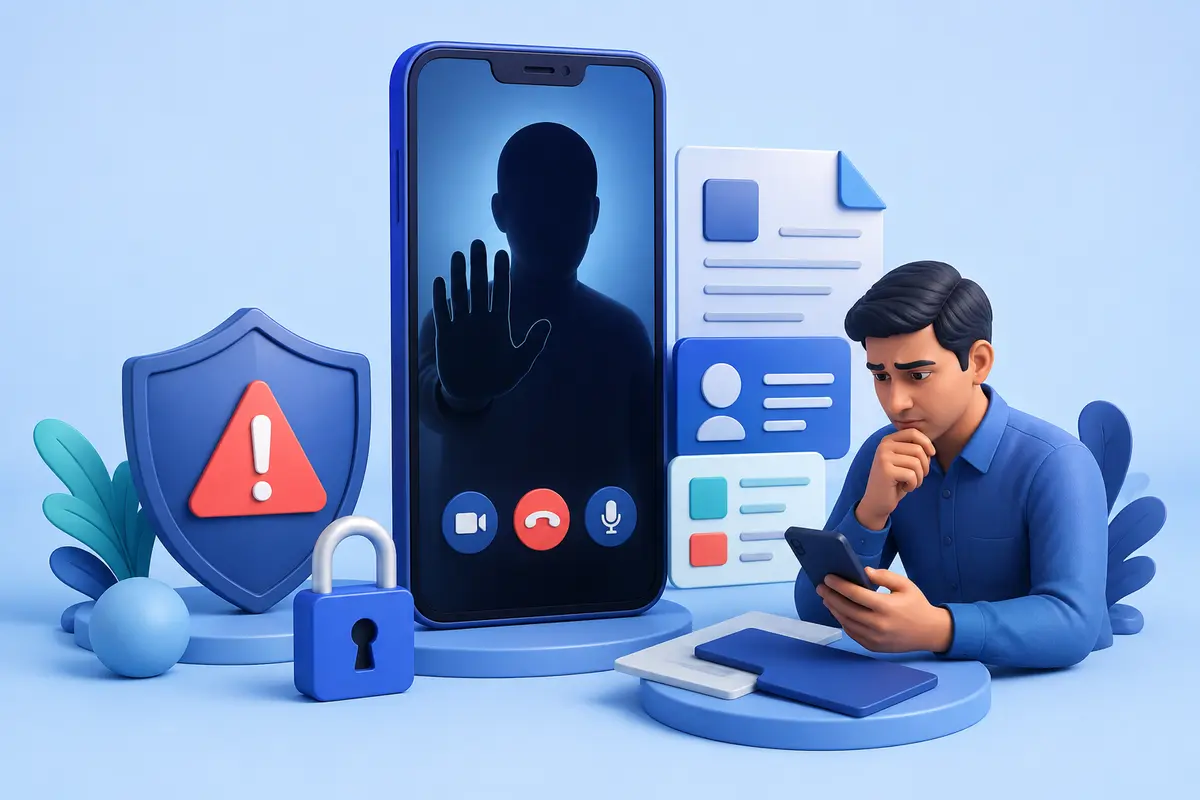
Important: There is no legal procedure called a “digital arrest” in which a person must remain on a video call or transfer money to a “safe account”.
How the scam usually begins
A caller claims that your mobile number, Aadhaar, bank account or courier parcel is connected to a crime. The call may be transferred to someone dressed as a police, CBI, customs, ED or other government officer.
Fraudsters may show forged ID cards, notices, court documents or a police-station background. They keep the victim isolated on a long video call and demand money for “verification”, “bail”, “security” or “account checking”.
Warning signs
- Threats of immediate arrest, account freezing or harm to family members.
- Instructions not to disconnect the call or speak to anyone.
- A demand to transfer funds, share OTPs, install an app or show your screen.
- Claims that money must be moved to an official or safe account.
What you should do
- Disconnect the call. Fear and urgency are being used to stop you from thinking.
- Do not transfer money or share Aadhaar, bank, card, PIN, OTP or screen-access details.
- Verify any claim independently using the official website or published office number—not a number supplied by the caller.
- Tell a trusted family member before taking any financial action.
If money or account access is already lost
- Call your bank or payment provider immediately and ask them to block the transaction or account.
- Call the national cyber-fraud helpline 1930 as quickly as possible.
- File a report at cybercrime.gov.in.
- Preserve screenshots, phone numbers, UPI IDs, transaction references, emails and chat history.
Official reference
This alert is based on the Government of India’s continuing public-awareness work and the NHRC’s June 2026 discussion on digital-arrest fraud. Read the official PIB release.